Friday, December 17, 2010
Piaget
This week in class we took a lot of notes and had a lot of discussions about childhood development. We learned about physical development and cognitive development. When we were learning about how young children cannot judge number and volume I thought of my little cousin. She has recently started to learn conservation of number and volume since she is almost 7 now but I remember in past years that she didn't yet know this concept. During Christmas and Thanksgiving we always have snack foods on the table before dinner or lunch is served. We typically have cheese with crackers, sausage, pickles, and olives. My little cousin loves pickles and this particular year we had both pickle spears and baby dill pickles. She asked for a pickle and instinctively grabbed a baby dill since those are what I typically eat but she demanded the other kind because the size was bigger. I could have given her 100 baby dills and she still would have wanted a pickle spear because her mind told her that a pickle spear would give her more pickle than a 100 small ones. Now that she is 7, she can determine that a tall, skinny glass and a short, fat glass can have the same liquid even though it appears that the tall, skinny glass has more.

Sunday, December 12, 2010
Agnosia
I loved learning about brain disorders this week. It was so interesting! My two favorites were Savant syndrome and Synesthesia. This made me wonder what other disorders are out there so I decided to research my own. I decided to research some information on Agnosia. Agnosia is a loss of knowledge. There are may diferent forms such as mirror agnosia where a person cannot tell if the object is real or a reflection. There is also color agnosia where a person cant recognize colors. Some of the causes include dementia, strokes, heredity, brain related injuries, or infections. some forms are genetic. Like all the other disorders, there is no medical cure, only ways to deal and cope with the disorder. Therapy is the most popular form of treatment and can sometimes reverse the effects of the disorder. Some of the symptoms are the inability to recognize people, colors, shapes, sounds, smells or objects. a patient has to go through many tests in order to be officially diagnosed with the disorder. If you want to hear more watch this VIDEO.
Ashalee :]
Ashalee :]
Friday, December 3, 2010
Left Brain vs. Right Brain
 This week I got really interested in the left brain vs. right brain debate. I took a lot of online quizzes and the one we took in class. All the quizzes that I took said I was slightly more left brained that right brained while only one said I was equally right brained and left brained. This quiz that I took said I was 58% left brained and continued to break down the percents and explain each category. Click HERE. It was really interesting in my opinion.
  After taking this quiz I learned a lot about the way I think. It told me that I do things in a logical systematic way, like making lists and schedules. It told me also that when solving math problems I typically like to draw pictures to help me solve them. One part I think this quiz was wrong about though was my Reality- Based Analysis. It said that I adjust easily to changes in my environment when I believe that I really do not. I do not like changes is things. I like when things stay routine but it was correct in the sense that I am not very verbal. I like to use images and gestures when explaining or talking to someone. Overall I thought this was one of the better quizzes out there and it does a lot of explaing which is interesting and helpful.
 Take the quiz yourself and post your results! :)
Sunday, November 21, 2010
Jung, Adler, and Horney
Jung's Theories
One of Jung's theories is the Collective Unconscious Theory. It contains three parts and it very similar to the Id, Ego, and Superego Theory of Freud. The first part is called the ego which is a person's conscious mind and thoughts. The second part is the personal unconscious which is very similar to the ego. The personal unconscious means anything that is currently unconscious but could be conscious. The part that makes this theory stand out from Freud's is the collective unconscious. This part refers to something we are born with or inherit during birth. Its our experiences across cultures and it influences behaviors and experiences mostly the emotionally ones. It's not our own personal opinions on things but everyone has a general sense of what love is. We all have an idea of what love is like but no one knows for sure what love is to them until they have personally experienced it. The next theory of Jung's is the Archetype theory which is part of the Collective Unconscious Theory. He says that everyone is born with a general sense of what a hero or archetype is. We all have a basis idea of good versus evil and we all know that guys like Superman are good guys and they are heroes. The fact that we all have this sense influences our behaviors and our actions.
Adler's Theories
Adler came up with a theory called the Inferiority Complex. This complex is something someone feels about themselves but towards another person or people. It happens when you think others are better than you and it is based on ego, power, dominance, and social status. An example would be if you were just dressed in normal jeans and and t-shirt and you walked into a high class restaurant. In this case you feel that everyone around you is "better" than you simply because they are wearing dressy clothing and eating in an expensive restaurant.
Karen Horney
Horney was a very intelligent women and greatly helped the field of psychoanalysis. She disagreed with Freud on the penis envy theory and believed that Freud was really trying to get to the point that women are simply jealous of how much power men have in the world compared to women. She thought that just like women were said to have penis envy, men also had womb envy. She believed that men were jealous that women were able to bear children and they were not. She also said that the Oedipus complex of Freud was wrong and over thought. She said that children clung to one parent and was jealous of the other because of anxiety. She thought this anxiety was caused by the relationship between a child and their parents. She also believed that the basis of one's core was the self. If someone had an accurate idea of themselves then they would be able to reach their full potential.
One of Jung's theories is the Collective Unconscious Theory. It contains three parts and it very similar to the Id, Ego, and Superego Theory of Freud. The first part is called the ego which is a person's conscious mind and thoughts. The second part is the personal unconscious which is very similar to the ego. The personal unconscious means anything that is currently unconscious but could be conscious. The part that makes this theory stand out from Freud's is the collective unconscious. This part refers to something we are born with or inherit during birth. Its our experiences across cultures and it influences behaviors and experiences mostly the emotionally ones. It's not our own personal opinions on things but everyone has a general sense of what love is. We all have an idea of what love is like but no one knows for sure what love is to them until they have personally experienced it. The next theory of Jung's is the Archetype theory which is part of the Collective Unconscious Theory. He says that everyone is born with a general sense of what a hero or archetype is. We all have a basis idea of good versus evil and we all know that guys like Superman are good guys and they are heroes. The fact that we all have this sense influences our behaviors and our actions.
Adler's Theories
Adler came up with a theory called the Inferiority Complex. This complex is something someone feels about themselves but towards another person or people. It happens when you think others are better than you and it is based on ego, power, dominance, and social status. An example would be if you were just dressed in normal jeans and and t-shirt and you walked into a high class restaurant. In this case you feel that everyone around you is "better" than you simply because they are wearing dressy clothing and eating in an expensive restaurant.
Karen Horney
Horney was a very intelligent women and greatly helped the field of psychoanalysis. She disagreed with Freud on the penis envy theory and believed that Freud was really trying to get to the point that women are simply jealous of how much power men have in the world compared to women. She thought that just like women were said to have penis envy, men also had womb envy. She believed that men were jealous that women were able to bear children and they were not. She also said that the Oedipus complex of Freud was wrong and over thought. She said that children clung to one parent and was jealous of the other because of anxiety. She thought this anxiety was caused by the relationship between a child and their parents. She also believed that the basis of one's core was the self. If someone had an accurate idea of themselves then they would be able to reach their full potential.
Wednesday, November 17, 2010
Experiments
Yesterday in class we watched a Youtube video where a present day reality show reenacted the famous experiment done by Milgram. Obviously we saw that that experiment was extremely unethical because is caused physical harm to the participants and the man in the white lab coat forced the participants to keep going even after they begged to stop. I found a description of an experiment I found unethical. Click HERE to read about the experiment.
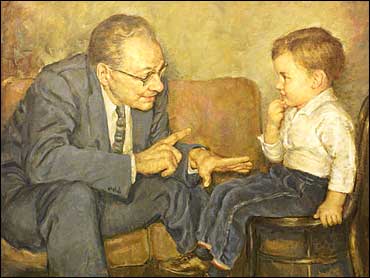 In short, a scientist from the University of Iowa collected 22 orphans who previously had no speech impediments. He randomly assigned them to one of to groups. One group would get positive enforcement when speaking and the other group would receive negative enforcement when speaking. The children who grew up with positive enforcement now speak normally while the children who received negative enforcement now have a permanent speech impediment. This experiment is extremely unethical because it involved very young children and it caused them extreme physical harm. He obviousy also could not get consent from the children or their parents because they were orphans. Overall this experiment is considered one of the top ive most unethical experiments ever conducted.
 You should read the story and post your thoughts. :)
Ashalee
Subscribe to:
Comments (Atom)